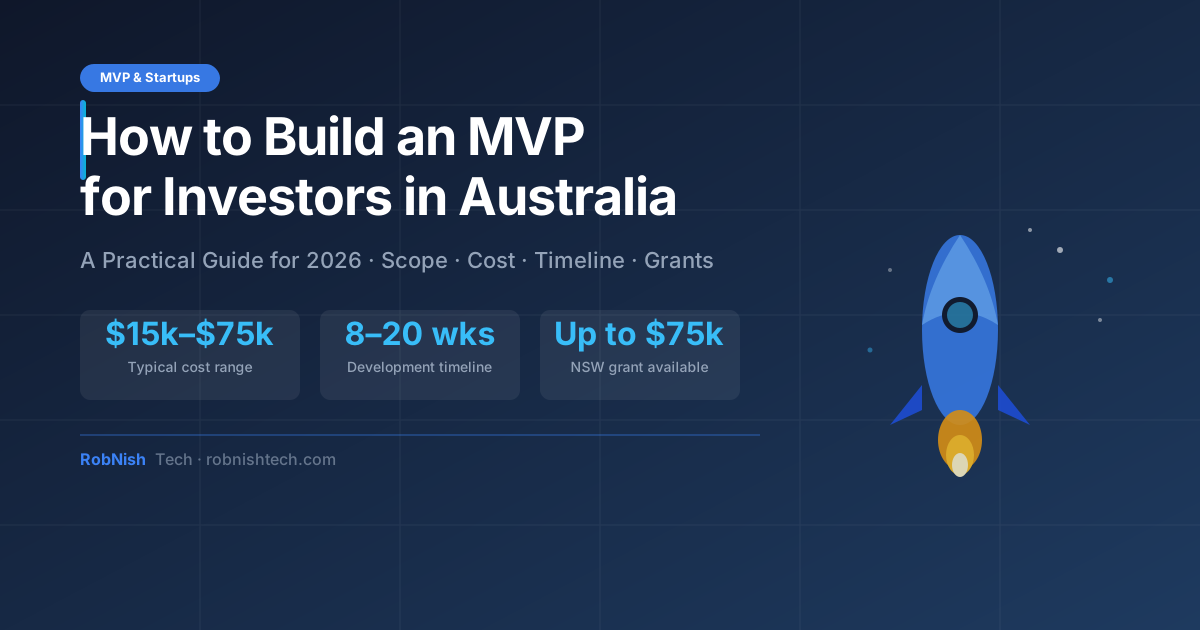
If you're a founder with an idea and a pitch deck, there's one thing most Australian investors want to see before they commit: a working product, or at least a credible version of one. That's where a Minimum Viable Product (MVP) comes in.
An MVP lets you validate your idea with real users, demonstrate traction, and give investors something concrete to evaluate — without spending a year and your life savings building a full product. This guide walks through what an MVP is, how to scope and build one properly, what it costs in Australia, and how to get it in front of the right people.
What Is an MVP (and What It Isn't)?
An MVP is the smallest version of your product that delivers enough value for a specific user to actually use it — and for you to learn whether the idea holds up in the real world.
The key word is minimum. An MVP is not a rough prototype you show in a Figma demo. It's also not a full product with every feature you've ever imagined. It's a deliberate, stripped-back build focused on proving one core outcome.
For a B2B SaaS startup, that might mean a working dashboard that solves one workflow problem for a handful of pilot customers. For a marketplace, it might mean a manually-operated version before any automation is built. The shape of the MVP depends on what you need to learn first.
What investors expect from an MVP
Evidence that real users will pay for, or consistently engage with, the product. A clear connection between the software and the problem being solved. A technical foundation that can be built on — not something that needs to be thrown away at the next stage.
An impressive pitch deck gets you a meeting. A working MVP is what closes a pre-seed or seed round.
Why Australian Investors Want to See an MVP
Australian startup capital is more cautious than Silicon Valley. Investors here tend to want evidence of traction — user sign-ups, paid pilots, or demonstrated engagement — before committing to early-stage deals.
A functional MVP changes the conversation from "could this work?" to "here's what we've learned so far." That shift is significant. It reduces perceived risk, makes the product real in the room, and gives the investor a reason to believe the team can actually execute.
The practical implication is straightforward: the earlier you can put a working product in front of users, the earlier you can start building the evidence trail investors respond to. An MVP doesn't need to be polished. It needs to be real.
How to Scope Your MVP
The most expensive mistake founders make is building too much. If your MVP scope is "everything we need to launch", it's not an MVP — it's a v1 product, and it will take three times as long and cost twice what you expected.
A better question to start with: what is the single problem my MVP needs to prove it can solve?
From there, a practical scoping process looks like this:
- Define the target user — Who specifically will use this? Not your eventual market, but the five to ten people you're going to pilot with first.
- Map the core workflow — What does the user need to do to get value? Draw it out step by step and cut everything that isn't essential to that flow.
- Separate "must have" from "nice to have" — Features that make the product stickier can come in version 2. The MVP needs to prove the core value proposition only.
- Set a success metric before you build — What would tell you the MVP is working? A number of active weekly users, a conversion rate, a retention figure. Define it upfront so you're building toward evidence, not just shipping code.
A well-scoped MVP might have three to five features. If your list has fifteen, you're planning a product launch, not an MVP.
The MVP Development Process
Once scope is agreed, a solid MVP development process follows these phases:
Discovery and design (weeks 1–3): Define user stories, confirm technical architecture, and create wireframes or basic UI designs. This phase prevents expensive rebuilds later. Skipping it is almost always a false economy.
Development (weeks 4–12): Build the core features iteratively. Prioritise working software over internal perfection. Use short cycles — typically two-week sprints — so you can make decisions based on what you're seeing rather than finishing a long build blind.
Testing and QA (weeks 12–16): Test core flows end to end. Fix critical bugs. Confirm the product works under realistic usage conditions.
Pilot and launch (weeks 16–20): Deploy to a small group of real users. Gather structured feedback. Track the metrics you defined in scoping.
The exact timeline depends heavily on scope and team composition. A narrow, well-scoped MVP with an experienced team can go from brief to pilot in eight to twelve weeks. A broader build with integrations and multi-platform support typically runs sixteen to twenty weeks.
For a detailed view of how RobNish Tech structures the discovery-to-launch process, see our development process page.
How Much Does an MVP Cost in Australia?
Cost depends on scope, team model, and how much discovery work has already been done. Broadly:
| Build type | Cost range | Timeline |
|---|---|---|
| Narrow scope, single platform, external dev team | A$15,000 – A$40,000 | 8–14 weeks |
| Mid-scope with integrations (e.g. Stripe, CRM) | A$40,000 – A$75,000 | 12–20 weeks |
| Complex, multi-platform or AI-integrated build | A$75,000 – A$150,000+ | 20+ weeks |
These ranges assume an experienced Australian or Australia-based team handling design, development, and QA. Offshore builds can reduce upfront costs but introduce coordination overhead, time-zone friction, and quality risk that often costs more to fix later.
The cost of doing MVP development properly — with discovery, design, and testing — is higher than the cost of just building. But it's reliably lower than the cost of rebuilding after launch because the scope or architecture was wrong.
If you're looking for a cost comparison across different software approaches, our custom software service page outlines where custom builds make sense versus off-the-shelf tools.
Timeline: What to Expect
A realistic MVP timeline for an Australian startup, assuming a focused scope and a dedicated team, looks like this:
- Weeks 1–3: Discovery and technical scoping
- Weeks 4–5: UI/UX design and user story refinement
- Weeks 6–14: Core development in iterative sprints
- Weeks 14–16: QA and bug fixing
- Weeks 17–18: Pilot deployment and feedback collection
That's roughly four to five months end to end for a standard build. A tighter scope with fewer integrations can compress this to ten to twelve weeks. Complex products — especially those with AI features, multiple user roles, or integrations into existing business systems — typically run longer.
One thing that consistently extends timelines: delayed decisions. If feedback on designs, user stories, and feature trade-offs takes days instead of hours, projects stretch. The most efficient MVP builds happen when a founder is actively involved and making decisions quickly.
Government Support: The NSW MVP Ventures Program
NSW-based founders have access to the MVP Ventures Program, administered through Investment NSW and listed on business.gov.au. The program offers grants to help startups take a prototype to pilot and market validation stage.
The current 2025–2026 funding details:
- Stream 1: Up to $50,000 with a 50% minimum co-contribution from the applicant
- Stream 2: Up to $75,000 for women-owned, regional, and First Nations businesses, with a 25% minimum co-contribution
Eligibility conditions apply, including that the product must be past concept stage but not yet commercially launched. Check the current program terms on the NSW Government Investment website before applying, as criteria and funding rounds change.
If you're building a grant-ready MVP in Sydney, having technical documentation, a clear scope, and a working prototype strengthens your application significantly. Businesses should confirm grant eligibility and obligations with the appropriate professional before applying.
When to Bring in a Development Partner
Some founders have the technical skills to build their own MVP. Most don't — or don't have the time. When evaluating whether to hire a development partner, consider:
Working with an external team makes sense if: you don't have a co-founder with deep technical skills, you need to move faster than in-house hiring allows, you want technical advice on architecture and scope (not just execution), or you need to produce investor-ready software rather than a rough prototype.
What to look for in a development partner: experience with startup builds and not just enterprise projects, a structured discovery process before any code is written, transparent scoping and pricing, and technical depth across the stack you need.
RobNish Tech specialises in MVP and SaaS development for Australian startups and growing businesses. We handle discovery, design, build, and launch — and we're based in Sydney, so in-person working sessions are available when useful. We've helped startups like GuChat refine their product and prepare for grant applications from Microsoft and Google. Read more about our work.
Frequently Asked Questions
What is an MVP and why do I need one for investors?
An MVP, or Minimum Viable Product, is the smallest version of your software that delivers your core value proposition to real users. Investors want to see an MVP because it demonstrates that you can build, that users engage with the product, and that there is evidence of demand — not just an idea.
How much does it cost to build an MVP in Australia?
A focused MVP with a single platform typically costs between A$15,000 and A$75,000 depending on scope, integrations, and team model. Complex builds with AI features or multi-platform requirements can exceed A$100,000. Discovery and design work should be included in the budget, not treated as optional.
How long does MVP development take in Australia?
A well-scoped MVP with an experienced team typically takes eight to twenty weeks from brief to pilot. Simple builds with narrow scope can ship in ten to twelve weeks. More complex products with integrations and multiple user roles run sixteen to twenty-plus weeks.
What is the NSW MVP Ventures Program?
The MVP Ventures Program is a NSW Government grant that provides funding for startups to take a prototype to pilot stage. Stream 1 offers up to $50,000 with a 50% co-contribution. Stream 2 offers up to $75,000 for women-owned, regional, and First Nations businesses with a 25% co-contribution. Check current eligibility and rounds on the NSW Government Investment website before applying, as criteria change each round.
Should I build my MVP in-house or work with a development company?
If you have a technical co-founder, in-house development can work well for early stages. If you don't have deep technical skills on the founding team or you need to move fast, working with an experienced development partner is usually faster, cheaper in total cost, and less risky than hiring and managing developers yourself.
What makes a good MVP from an investor's perspective?
Investors respond to MVPs that demonstrate real user engagement, a clear connection between the product and the problem, and a team that understands what they've built and why. Polished design helps, but traction matters more — evidence that users will pay for, or regularly come back to, the product.
Ready to Build Your MVP?
We build MVPs, SaaS platforms, and custom software for Australian startups and growing businesses. Based in Sydney, working across Australia.
Book a Free Consultation