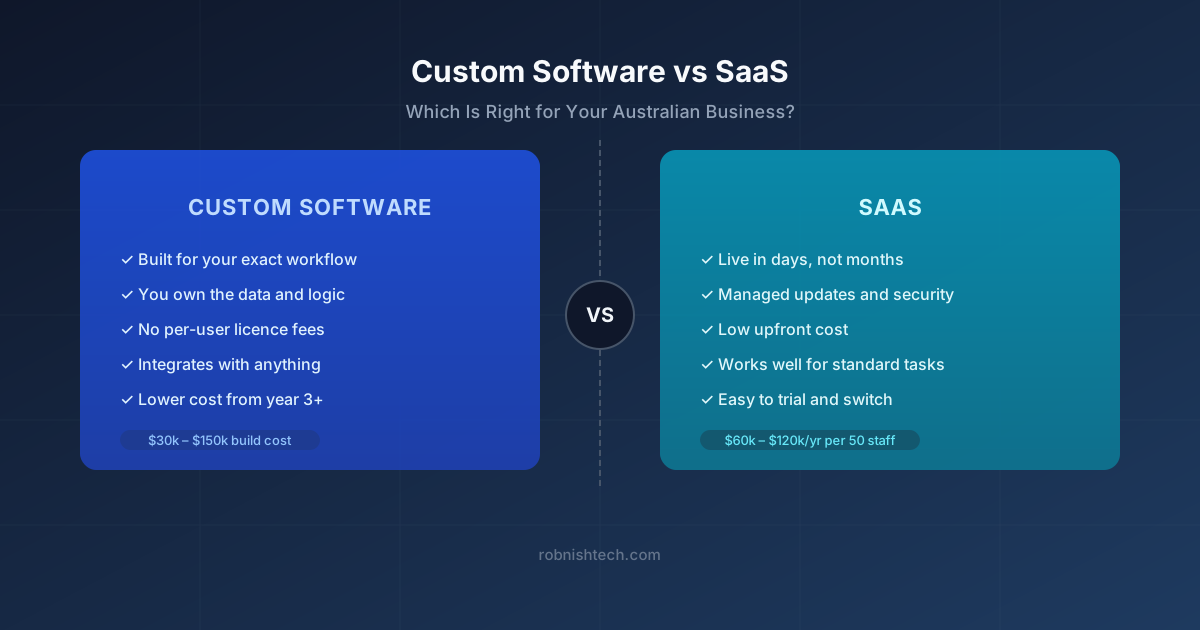
Most Australian businesses start with SaaS. It's fast, affordable upfront, and there's usually a tool for every problem. Then, somewhere around year two or three, something shifts. The stack grows to a dozen subscriptions, the tools don't talk to each other, and your team is still filling in spreadsheets to bridge the gaps.
That's the moment when the question comes up: should we build something custom instead?
This guide lays out the honest comparison. There's no single right answer, but there are clear signals that point one way or the other — and the decision is worth getting right before you're locked into either path.
What We Mean by Custom Software and SaaS
SaaS (Software as a Service) is software hosted and managed by a vendor that you access via subscription. Think Xero for accounting, HubSpot for CRM, Slack for messaging, or any of the hundreds of tools in a typical business stack. You pay monthly or annually, get updates automatically, and share the infrastructure with thousands of other customers.
Custom software is software built specifically for your business — your workflows, your data model, your integrations, your rules. It takes longer and costs more to build, but the result is a system that does exactly what your operation needs, rather than what the vendor thought most of their customers might need.
The practical question isn't which one is better in theory. It's which one makes sense for your business, at your current size, with your specific workflow.
When SaaS Is the Right Choice
SaaS works best when your business needs to solve a common, well-defined problem quickly.
If you're looking for email, document management, basic accounting, standard HR, or a generic CRM, you're buying into something that thousands of other businesses already use and trust. The vendor has done the hard work of building, securing, and maintaining the system. Your job is to configure it and use it.
SaaS is also the right choice when:
- You're early-stage. If your business model or workflows are still changing, locking in a custom build is premature. SaaS lets you move fast and change tools without writing off a large development investment.
- The category is commodity. Some software categories — invoicing, payroll, video calls — are mature and well-served. There's no competitive advantage to building your own.
- Your team is small. At under 20 staff, per-user SaaS pricing is manageable and the overhead of running custom software isn't worth it.
- You need it working this month. A well-chosen SaaS tool can be live in days. A custom build takes weeks to months.
When Custom Software Makes More Sense
Custom software earns its cost when your workflow is genuinely different from what off-the-shelf tools assume.
Here are the clearest signals:
You're patching SaaS with spreadsheets. If your team routinely exports data from one tool and re-imports it into another, or maintains a spreadsheet to track things no tool quite handles, that's a gap. Over time, those patches become a reliability and accuracy risk.
Your per-seat SaaS costs are scaling painfully. At $40–$80 per user per month across multiple tools, the maths shifts as your team grows. A business with 50–100 staff paying for three or four SaaS tools can easily exceed $150,000 per year in licences alone.
You have a proprietary process. If the way your business operates is a genuine competitive advantage, it probably doesn't map neatly onto a generic tool. Custom software lets you encode your process exactly.
You're building a product, not just running operations. If the software is part of what you're selling — a client portal, a booking system, a data platform — custom is often the only sensible path.
Integrations are failing or fragile. SaaS tools integrate with each other when vendors choose to support it. Custom software can integrate with anything that has an API, on your terms. If you'd like to understand more about what's possible, our API Integration and Automation service covers this in detail.
The Real Cost Comparison
This is where most comparisons get vague. Let's be specific.
SaaS costs over time
A typical growing Australian business (20–50 staff) running a standard stack — CRM, project management, accounting, communication, HR, document management — can easily spend $60,000 to $120,000 per year in combined SaaS subscriptions. Most SaaS vendors raise pricing annually, and per-user fees compound as headcount grows.
Over five years, that same stack often exceeds $400,000 in licence costs alone, before counting integration effort, workarounds, and staff time lost to manual processes.
Custom software costs
A well-scoped custom business system built in Australia typically ranges from $30,000 for a focused internal tool to $150,000 or more for a comprehensive platform. Ongoing maintenance and support generally runs 15–20% of the build cost per year.
A $60,000 custom system with $12,000 per year in maintenance costs $120,000 over five years. If it replaces $40,000 per year in SaaS subscriptions, it has paid for itself by year three.
Key Takeaway
SaaS is cheaper upfront. Custom software is often cheaper over three to five years — but only if the build is properly scoped and the ongoing maintenance is factored in from the start.
The important caveat
These numbers only make sense if the custom system is scoped and built properly. An underspecified build that keeps changing mid-project will cost more and deliver less. That's why the scoping and discovery phase matters — it's where the real costs are contained. You can learn more about how RobNish Tech approaches that on our process page.
A Decision Framework: Five Questions Worth Asking
If you're sitting in the middle — not sure whether SaaS or custom is right — these questions help:
- Is the workflow standard or unique? Standard workflows belong on SaaS. Unique workflows are candidates for custom.
- How much are you currently spending on subscriptions, and what's the trajectory? Run the five-year number.
- How many manual steps exist between your tools? Every manual handoff is a cost and a risk.
- Do you need to own the data and the logic? SaaS keeps your data in the vendor's system. Custom software means you own the data model and the business rules.
- Is this a cost centre or a competitive asset? Tools that run background operations are cost centres. Tools that differentiate your service or product are assets worth investing in.
The Hybrid Approach
Most businesses that move to custom software don't abandon SaaS entirely. The smarter move is often to keep the commodity tools (Xero, Slack, Google Workspace) and build custom software for the pieces that are genuinely unique — or to build middleware that connects your SaaS tools more reliably than their native integrations allow.
This hybrid approach is often where the best return on investment sits. You're not rebuilding accounting software from scratch; you're building the operations layer that your existing tools can't cover. Our API Integration and Automation service is specifically designed for this kind of work, and our Custom Software Development service handles the cases where a full build is the right answer.
What This Looks Like in Practice
A professional services firm running five SaaS tools for quoting, project management, invoicing, time tracking, and client communication might find that each tool works fine on its own but requires constant manual data entry to keep them in sync. The realistic fix is a custom integration layer — not replacing everything, but connecting the tools to eliminate the manual steps.
A logistics business with a genuinely unique dispatch and tracking workflow might find that no off-the-shelf tool handles their specific requirements. The custom build is more expensive upfront, but the operational efficiency gain justifies it within 18 to 24 months.
Both decisions are rational. The difference is in the specific situation. If you are weighing up the timing of a build, our guide on when to invest in custom software covers the signs your business is ready. And if you'd like a clear view on which path makes sense for your business, our free consultation is a good starting point.
Frequently Asked Questions
How much does custom software cost in Australia?
Custom software in Australia typically ranges from $30,000 for a focused internal tool to $150,000 or more for a full platform. The range is wide because scope varies significantly. A well-run discovery process before build start is the most reliable way to get an accurate number for your specific needs.
How long does it take to build custom software?
A focused custom system takes roughly 8–16 weeks to build and launch, depending on scope. More complex platforms with multiple integrations can take 4–6 months. Modern development tools and frameworks have reduced timelines compared to five years ago.
Is SaaS always cheaper than custom software?
Upfront, yes. Over three to five years, it depends on your team size, how many tools you're running, and what your per-user costs look like. At 30–50 staff running $60,000 or more per year in SaaS subscriptions, the break-even on a well-scoped custom system is often reached in two to three years.
What is the biggest risk with custom software?
Underspecified scope and poor requirements are the most common reasons custom builds go over time or budget. The risk is manageable with a structured discovery phase, clear documentation, and a development partner who asks the right questions before writing code.
Can I start with SaaS and move to custom software later?
Yes, and this is often the right sequence. Use SaaS to validate your workflow and understand what you actually need. Build custom once the workflow is proven and the limitations of off-the-shelf tools are clear. The main cost of switching is the migration effort, which is manageable if your SaaS data is well-structured.
Does RobNish Tech build both custom software and integrations between SaaS tools?
Yes. We work across the full range — from standalone custom systems to custom integrations that connect your existing SaaS tools. The right approach depends on what your workflow needs. Start with a free consultation and we can give you a direct view on what makes sense.
Need Help With Your Next Project?
We build custom software, integrate AI, and automate workflows for businesses across Australia.
Get in Touch