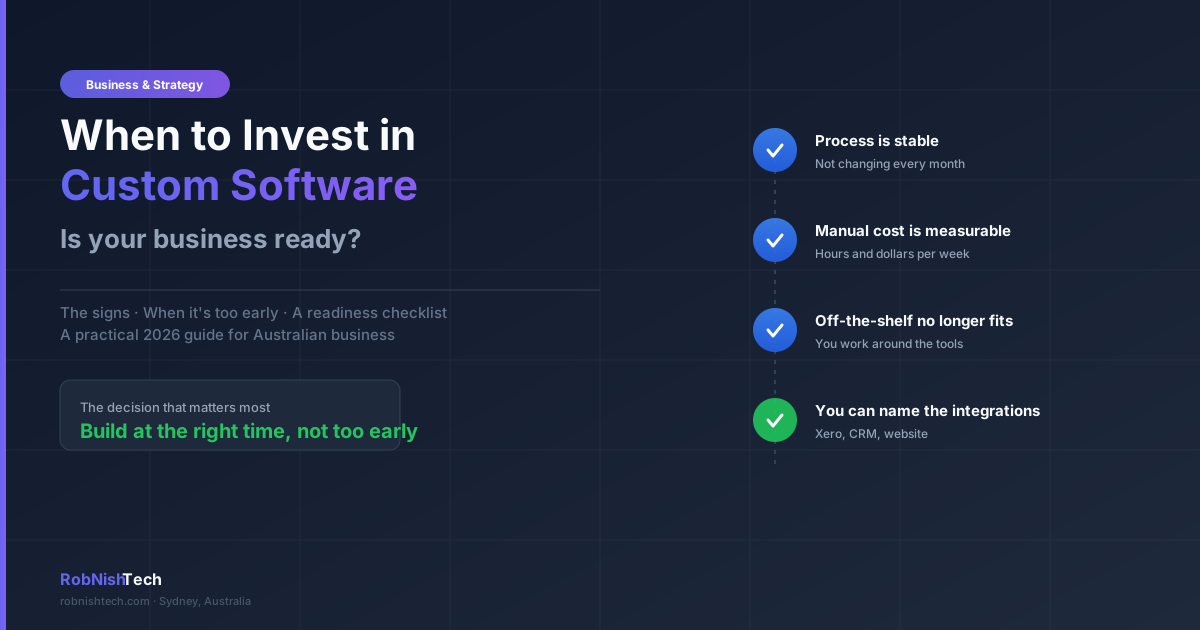
Custom software is one of the larger investments a growing business makes, and the timing matters as much as the build itself. Spend too early and you pay to automate a process that is still changing every month. Wait too long and the accumulated cost of manual work, errors, and disconnected tools quietly exceeds what a proper system would have cost in the first place.
This guide is for Australian business owners, operations managers, and founders trying to work out whether now is the right time to invest in custom software, or whether an off-the-shelf tool will do for a while longer. We will cover the clear signals of readiness, the situations where it is too early, a simple way to justify the cost, and a checklist you can run before talking to anyone.
What "investing in custom software" actually means
Custom software is a system built specifically for how your business works, rather than a subscription product you adapt your business to fit. That can mean an internal tool that replaces a tangle of spreadsheets, a client portal, a quoting or job-management system, or an integration layer that connects the tools you already pay for.
The decision is rarely "custom software or nothing". In practice it is a build-versus-buy question. Off-the-shelf SaaS is faster to start and cheaper up front. Custom software costs more initially but fits your process exactly, removes per-seat licensing as you grow, and you own it. If you want a deeper breakdown of that trade-off, our guide on custom software vs SaaS walks through cost, flexibility, and ownership in detail.
Sign 1: Your team works around the tools, not through them
The clearest signal is when the workaround becomes the workflow. If your team exports data from one system, reshapes it in a spreadsheet, then re-enters it somewhere else, the tool has stopped serving the business. You are effectively running two systems and paying for one.
A few specific patterns worth watching for:
- A "master spreadsheet" that several people edit and that nobody fully trusts.
- Copy-paste steps between your CRM, your accounting tool, and a job tracker.
- Staff who keep private notes or shadow spreadsheets because the official system cannot do what they need.
When work routinely happens outside your software rather than inside it, you are paying in time and errors every week. Our article on 5 signs your business has outgrown spreadsheets covers this pattern in more depth.
Sign 2: Off-the-shelf software no longer fits your process
Most businesses start with SaaS, and that is the right call early on. The problem appears when you are bending your process to fit the tool, paying for features you do not use, or stacking three subscriptions to cover what one custom tool could do cleanly.
Ask yourself whether the off-the-shelf product is genuinely close to your process or just close enough that everyone has quietly accepted the friction. If your operations rely on a workflow that is a real competitive advantage, forcing it into a generic product can slowly erode the thing that makes you better than your competitors.
Sign 3: The manual cost is now measurable
Readiness becomes obvious when you can put a number on the inefficiency. If two staff each lose five hours a week to manual data entry, reconciliation, or chasing information between systems, that is roughly ten hours a week, or around 500 hours a year, before you count the errors those manual steps introduce.
For internal tools, a common rule of thumb is that a team of roughly eight to twelve people using a well-built custom system often recovers the build cost within twelve months through time savings alone. That will not hold for every project, but it is a useful test: if the annual cost of the manual process is approaching the cost of building software to remove it, the maths is starting to favour the build. We cover this calculation properly in our custom software ROI guide.
Sign 4: You know which systems it needs to connect to
A quietly reliable signal of readiness is integration clarity. If you can name the two or three systems a new tool must connect to, such as Xero, your CRM, and your website, the problem is well defined enough to build for. Vague integration requirements usually mean the process needs more definition first.
Connecting tools you already use is also one of the lower-risk ways to start. Rather than replacing everything at once, an API integration can sync data between your accounting, CRM, and operations tools and remove a large slice of manual work without a full rebuild. For a concrete CRM example, see our HubSpot integration services guide for Australian businesses.
When it is too early to invest
Custom software is not always the answer, and building too early is a real risk. It is usually too early when:
- Your process is still changing month to month. Building software around a workflow that has not settled means paying to rebuild it.
- A mainstream SaaS product genuinely covers 80 to 90 percent of what you need at a reasonable per-seat cost.
- The pain is annoying but not measurable. If you cannot estimate the hours or dollars lost, you cannot justify the spend yet.
- You are very early stage and still validating whether the business itself works.
A good middle path is to start with off-the-shelf tools and lightweight automation, then revisit custom software once the process is stable and the cost of the workaround is clear. There is no prize for building early.
Key Takeaway
Invest in custom software when your process is stable, the manual cost is measurable, off-the-shelf tools no longer fit, and you can name the systems it must connect to. If your workflow is still changing or a SaaS product covers most of your needs, it is usually too early.
How to estimate the cost before you commit
Once you suspect you are ready, the next question is what it costs. In Australia in 2026, a small internal tool typically starts in the low thousands, a solid business application sits in the tens of thousands, and a larger platform with multiple integrations and user roles runs higher again. The range is wide because scope, integrations, and user roles drive most of the cost. Our guide to custom software cost in Australia breaks down realistic figures by project type.
You do not need a full specification to get a useful estimate, but you do need clarity on the core problem, who uses the system, and what it connects to. A short discovery phase exists for exactly this. It turns a vague idea into a costed plan with a defined scope, so you can decide whether to proceed before committing to a full build. You can see how we approach scoping and delivery on our process page.
A readiness checklist
Before you talk to a developer, run through these questions. The more you answer "yes", the more likely now is the right time to invest:
- Is the process you want to improve stable, or still changing every month?
- Can you estimate the hours or dollars the current manual process costs each week?
- Have you outgrown, or started fighting, your off-the-shelf tools?
- Can you name the two or three systems the new software must connect to?
- Is there a real operational advantage in doing this your way rather than a generic way?
- Do you have a rough budget range in mind, and a sense of the return you would expect?
If most of these are clear, you are in a strong position to scope a project. If several are still fuzzy, spend a little more time defining the problem first. The cost of clarity up front is always lower than the cost of building the wrong thing.
What to do next
If you have read this far and recognised your business, the sensible next step is not a full build, it is a conversation about scope. A short discovery conversation will tell you whether a custom software build is worth it for your situation, what it might cost, and whether a lighter automation or integration would get you most of the way there for less.
We work with startups and growing businesses across Australia, and we would rather tell you it is too early than sell you a system you are not ready for. You can read more about how we work on our about page or browse related guides on the blog.
Frequently Asked Questions
How do I know if my business is ready for custom software?
You are likely ready when your process is stable, your team regularly works around your existing tools, the manual cost is measurable, and you can name the two or three systems the software needs to connect to. If your workflow is still changing every month or a mainstream SaaS product covers most of your needs, it is usually too early.
Is custom software worth it for a small business in Australia?
It can be, when the cost of the manual process it removes approaches the cost of building it. A common test is that a team of eight to twelve people using a custom internal tool often recovers the build cost within about twelve months through time savings. For very early-stage businesses or unsettled processes, off-the-shelf tools are usually the better first step.
When is it too early to invest in custom software?
It is too early when your process is still changing frequently, when a SaaS product genuinely covers most of your needs at a reasonable cost, or when the pain is annoying but you cannot estimate the time or money it costs. Building around an unsettled workflow usually means paying to rebuild it later.
How much does custom software cost in Australia in 2026?
Costs vary widely with scope. Small internal tools typically start in the low thousands, business applications run into the tens of thousands, and larger platforms with multiple integrations cost more again. Scope, integrations, and the number of user roles drive most of the price. A short discovery phase is the best way to get a realistic figure for your project.
Should I start with off-the-shelf software or build custom?
Most businesses should start with off-the-shelf tools and lightweight automation, then move to custom software once the process is stable and the cost of the workaround is clear. Custom software makes the most sense when generic tools no longer fit your process or when your workflow is a genuine competitive advantage.
Do I need a full specification before getting a quote?
No. You need clarity on the core problem, who will use the system, and what it must connect to. A discovery phase turns that into a defined scope and a costed plan, so you can make an informed decision before committing to a full build.
Need Help With Your Next Project?
We build custom software, integrate AI, and automate workflows for businesses across Australia.
Get in Touch