Your business has years of knowledge locked in documents, policies, emails, and databases. When you ask a generic AI tool about it, you either get hallucinated answers or a generic response that ignores everything you've actually built.
RAG — Retrieval-Augmented Generation — solves this. It connects large language models to your real business data, so AI answers are grounded in your actual content, not training data from the internet.
This article explains what a RAG pipeline is, how it works, when it makes sense for an Australian business to build one, what it costs, and how to get started. If you're already familiar with AI integration broadly, this covers the next level of specificity — see our AI integration guide for small business for the wider picture.
What Is a RAG Pipeline?
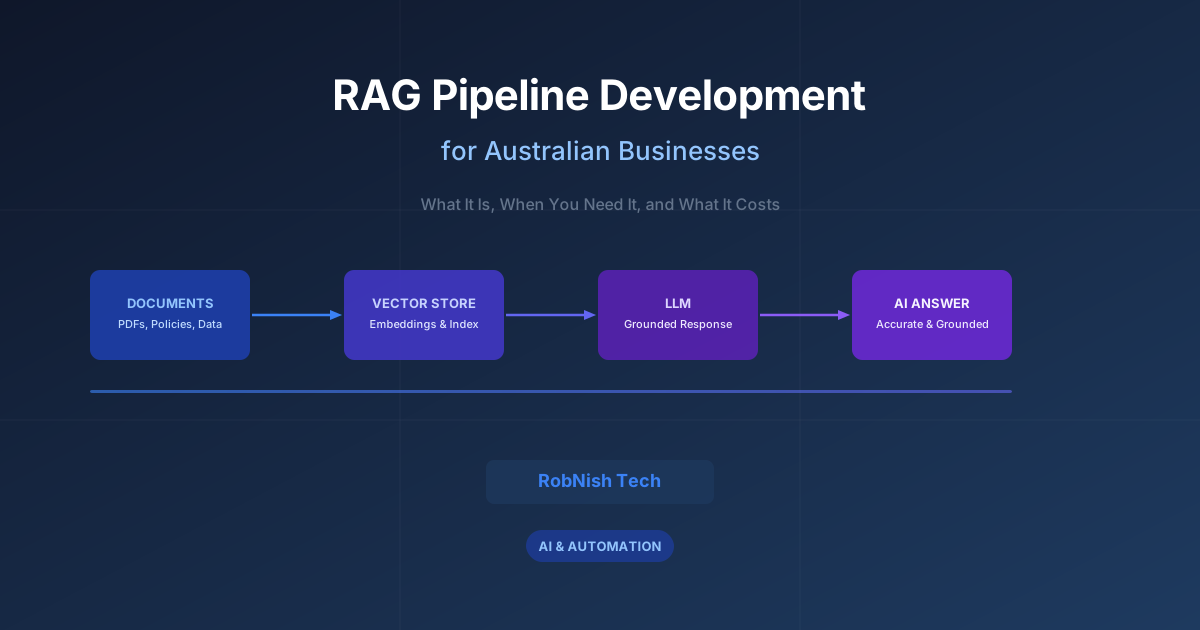
A RAG pipeline is an AI architecture that retrieves relevant information from a knowledge source before generating a response. Instead of relying on a model's pre-trained knowledge alone, RAG pulls context from your documents, database, or content in real time — then generates an answer using that retrieved information as the basis.
Think of it as giving your AI a library to consult before answering. The model doesn't just guess; it looks things up first.
RAG is used to build:
- Internal knowledge base chatbots — staff ask questions, AI answers from your policies and manuals
- Customer-facing support tools that pull from your product documentation
- Contract and document search and summarisation tools
- AI-powered assistants that query unstructured business data
- Compliance and regulatory query tools for legal, healthcare, and finance teams
Key Takeaway
RAG doesn't make AI smarter. It makes AI answers more accurate by grounding them in your actual documents and data, rather than general training knowledge.
How a RAG Pipeline Works
A RAG pipeline has three core stages. Understanding each one helps you make informed decisions about architecture, tooling, and cost.
1. Ingestion and chunking
Your source documents — PDFs, Word files, web pages, database records — are processed and split into smaller chunks. The chunk size matters: too large and retrieval becomes imprecise; too small and context gets lost. A well-designed ingestion pipeline also handles document updates, deletions, and version control.
2. Embedding and vector storage
Each chunk is converted into a numerical vector — an embedding — using a model like OpenAI's text-embedding-3-small, Cohere's embedding models, or a locally hosted open-source equivalent. These vectors are stored in a vector database such as Pinecone, Weaviate, Qdrant, or pgvector (a PostgreSQL extension). The vector store allows fast semantic similarity search at query time.
3. Retrieval and generation
When a user asks a question, the same embedding process runs on the query. The pipeline finds the most semantically similar chunks in the vector store and passes them to the language model as context. The model then generates a response grounded in those retrieved chunks, not its general training data.
A well-built production RAG pipeline also includes re-ranking to improve retrieval precision, metadata filtering to narrow searches by date or document type, guardrails to handle out-of-scope queries, and logging to track answer quality over time.
When Does Your Business Need RAG?
RAG makes sense when you have a meaningful body of proprietary content and a genuine need for AI to reason over it accurately.
Practical triggers:
- You have 50 or more internal documents — manuals, policies, SOPs, contracts — that staff regularly need to reference
- Customers ask repetitive support questions that your existing documentation already answers
- You've tried a generic AI tool and it keeps getting business-specific facts wrong
- You want AI search over your product catalogue, compliance documentation, or knowledge base
- Your team spends significant time manually looking up internal information
RAG is less appropriate when your knowledge fits comfortably in a system prompt, or when accuracy requirements are low enough that a standard LLM performs adequately without retrieval. A good development partner can help you determine which approach suits your situation before you commit to a build.
For businesses already using automation, RAG pairs well with API and workflow automation — the same data sources that feed your automations can often feed your RAG pipeline.
RAG vs Fine-Tuning: Which Should You Choose?
This is one of the most common questions when businesses start exploring AI more seriously. They solve different problems.
Fine-tuning trains a model on your data, changing its weights. It's useful when you want the model to behave differently — to respond in a specific tone, follow a particular format, or understand domain-specific vocabulary. It doesn't reliably give the model access to new facts.
RAG keeps the model weights unchanged and feeds it context at inference time. It's better for question-answering over documents, keeping answers current as your documents change, and grounding responses in specific source content that can be audited.
For most Australian businesses, RAG is the right starting point. It's faster to build, easier to update, more auditable, and more controllable than fine-tuning. You can add new documents to the pipeline without retraining anything. Fine-tuning may become relevant later, when you need the model to consistently follow a particular style or domain-specific behaviour.
What Does RAG Implementation Cost in Australia?
Costs depend on scope, data volume, integrations required, and whether you're using cloud-hosted or self-hosted models. Here are realistic ranges for Australian businesses in 2026.
| Scope | Description | Estimated Cost (AUD) |
|---|---|---|
| Proof of concept | Small document set, basic chat interface, cloud LLM | $8,000 – $18,000 |
| Production RAG system | Proper ingestion pipeline, re-ranking, admin tools, API integration | $25,000 – $60,000 |
| Enterprise system | On-premises or private cloud, compliance controls, multi-source retrieval | $70,000 – $150,000+ |
Ongoing running costs depend on API usage (typically $200–$2,000/month for cloud LLM calls depending on query volume) and hosting ($100–$800/month for vector database and infrastructure).
These are starting-point estimates. The right figure depends on your specific documents, integrations, access control requirements, and whether data needs to remain within Australian infrastructure. For regulated industries — healthcare, legal, financial services — on-premises or Australian-region-hosted deployments add to cost but are often non-negotiable.
Key Questions to Scope a RAG Project
Before committing to a build, these questions shape both the architecture and the budget:
- What is the source data? PDFs, Word documents, database records, web pages? How many documents? How often does the content change?
- Who are the users? Internal staff only, or customers? How many concurrent users at peak?
- What integrations are needed? Does the chatbot or search tool need to connect to your CRM, helpdesk, or existing business software?
- What are the accuracy requirements? A customer-facing support tool needs tighter guardrails than an internal search assistant.
- Data sovereignty and compliance? Some industries in Australia require data to stay within Australian infrastructure. This shapes model and hosting choices significantly.
Our development process starts with a scoping session that works through exactly these questions before any estimate is given.
How to Get Started
A sensible path for most businesses:
- Define the use case clearly. What question do users ask, and what documents currently hold the answer? A narrow, well-defined use case produces a better PoC than a broad "AI over everything" brief.
- Audit your source content. Is it structured enough to ingest? Does it have clear, accurate answers, or is it full of contradictions and outdated information? Source quality directly affects retrieval quality.
- Start with a proof of concept. A scoped PoC on a limited document set lets you test retrieval quality, user experience, and accuracy before committing to a full build.
- Choose a model and retrieval stack based on your privacy, cost, and performance requirements. Cloud APIs are faster to start; self-hosted models are better for sensitive data.
- Plan for ongoing maintenance. RAG pipelines need document refresh cycles, quality monitoring, and periodic evaluation of retrieval accuracy as your content evolves.
If you're not sure where to start, the right move is a conversation with a development team that has built RAG systems before — not a generic AI platform that locks you into their tooling. Our AI integration service covers the full build from scoping through to deployment and support.
Frequently Asked Questions
What is RAG in AI?
RAG stands for Retrieval-Augmented Generation. It is an AI architecture that combines a large language model with a retrieval system. When a user asks a question, the pipeline first searches a knowledge base for relevant content, then passes that content to the language model to generate a grounded response. It improves accuracy and reduces hallucinations compared to using a language model alone.
How is RAG different from a regular AI chatbot?
A standard AI chatbot uses only the language model's pre-trained knowledge to generate responses. A RAG-based chatbot retrieves relevant information from your specific documents or database before generating an answer. This means the responses are grounded in your actual content rather than general training data, and the answers can be updated simply by updating your documents.
How much does a RAG system cost to build in Australia?
For a production-ready RAG system, Australian businesses should budget between $25,000 and $60,000 AUD for development, depending on data volume, integrations, and infrastructure requirements. A smaller proof of concept can be built for $8,000–$18,000. Ongoing running costs typically range from $300 to $2,500 per month depending on query volume and hosting choice.
Do I need to fine-tune a model to use RAG?
No. RAG works with off-the-shelf language models and does not require fine-tuning. You provide your documents, and the pipeline retrieves relevant content at query time. Fine-tuning is a separate process that modifies the model's weights and is generally not necessary for document question-answering use cases.
Can I keep my data in Australia when using RAG?
Yes. A RAG pipeline can be built using Australian cloud infrastructure and locally hosted or Australian-region-hosted models. If data sovereignty is a requirement for your industry — for example, healthcare, legal, or government — this can be scoped into the architecture from the start without compromising performance.
Need Help With Your Next Project?
We build custom software, integrate AI, and automate workflows for businesses across Australia.
Get in Touch