If you've asked your team how they handle repetitive customer enquiries, the answer is probably "manually, one by one." AI chatbots have become one of the most practical ways for Australian businesses to automate those interactions — cutting response times, reducing support load, and keeping customers engaged outside business hours.
This guide is for business owners and operations managers who are evaluating whether an AI chatbot is worth building, what it should actually do, and how much it costs in Australia. We'll cover the real options, trade-offs, and what a proper build looks like — without the hype.
What Is an AI Chatbot (and What It Isn't)
An AI chatbot is a software system that converses with users through text or voice, using artificial intelligence to understand questions and generate useful responses. Modern AI chatbots go well beyond old-style rule-based bots that followed rigid decision trees.
Today's chatbots are typically powered by large language models (LLMs) like GPT-4, Claude, or Gemini. When combined with your business's own data — product catalogues, FAQs, policy documents, service guides — through a technique called Retrieval-Augmented Generation (RAG), they can answer questions accurately and in context.
What they are not: a plug-and-play solution. A generic AI widget dropped onto your website without configuration will produce vague, sometimes incorrect answers that reflect poorly on your brand. A properly built AI chatbot requires scoping, integration, testing, and ongoing maintenance.
It also helps to know where a chatbot stops. If you need the system to take actions on its own — updating records, triggering workflows, or working through multi-step processes — that moves into AI agent territory, which we cover separately.
Common Use Cases for Australian Businesses
The businesses that get the most value from AI chatbots tend to have high enquiry volume with a repeatable pattern. Typical use cases include:
Customer support and FAQs. Answering questions about pricing, availability, service coverage, business hours, and policy — available 24/7 without adding headcount.
Lead qualification. Engaging website visitors, collecting contact details, and routing qualified leads to your sales team with context already captured.
Appointment and booking assistance. Guiding users through booking flows, checking availability, and sending confirmation details — particularly useful for trades, clinics, and professional services.
Internal knowledge bases. Letting your team query internal documents, procedures, or HR policies through a conversational interface instead of searching through folders.
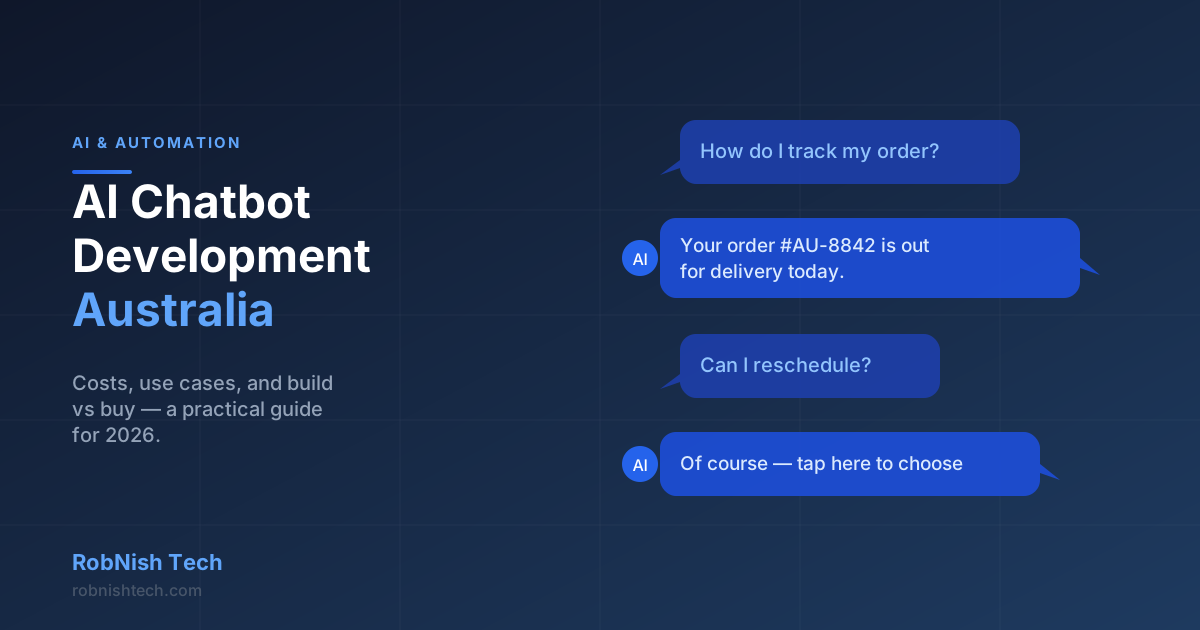
Order and account status. Connecting to your CRM, e-commerce platform, or ERP to give customers real-time updates on orders, invoices, or service requests.
Each use case has different integration requirements. A customer support chatbot that draws on a static FAQ document is simpler than one that needs to query live order data from your ERP. Scope it clearly before you commit.
Build vs Buy: The Australian Market Reality
You have three broad options:
Off-the-shelf tools (e.g. Intercom, Zendesk, Freshdesk AI). These are subscription SaaS products with chatbot features baked in. They're fast to set up and work well if your needs are standard. Monthly costs typically range from $150–$1,500 AUD depending on the plan and contacts. The limitation is customisation — you're constrained to the vendor's feature set, data handling, and pricing model.
No-code / low-code bot builders (e.g. Voiceflow, Botpress, Tidio). These sit between SaaS and custom development. You can build conversational flows without writing code, and some support LLM integration. Good for simpler use cases, but they hit a ceiling quickly when you need deep integration with your own systems.
Custom AI chatbot development. Built specifically for your business, integrated with your data sources, designed to match your brand voice, and owned by you. Higher upfront cost, but no recurring SaaS licences, no vendor lock-in, and full control over what the chatbot does and how it handles data.
For most growing Australian businesses with specific workflows or proprietary data, custom development delivers more long-term value than trying to force a generic tool to fit. If you're unsure where your situation lands, our AI integration service can help you evaluate the right approach.
How Much Does an AI Chatbot Cost in Australia?
Cost depends heavily on scope, integrations, and whether you need ongoing support. General ranges for the Australian market in 2026:
| Scope | Estimated Cost (AUD) |
|---|---|
| Simple FAQ chatbot (static knowledge base, no integrations) | $8,000 – $20,000 |
| Mid-tier chatbot (RAG over your documents + CRM read access) | $20,000 – $60,000 |
| Complex chatbot (multi-system integrations, live data, custom UI) | $60,000 – $150,000+ |
| Ongoing maintenance and updates (monthly) | $500 – $3,000+ |
These are approximate ranges. A proper scoping session will give you a more accurate estimate based on your data volume, integration complexity, and hosting requirements. If a provider quotes you a fixed price without understanding your systems first, treat that as a warning sign.
We offer a free consultation to help you scope AI projects before any commitment — get in touch here.
What a Proper AI Chatbot Build Looks Like
A well-structured AI chatbot project has several distinct phases:
Discovery. Understanding your use case, user types, data sources, integration requirements, and success criteria. This is the most important phase — a chatbot built without a clear problem statement will not perform well. Our process page outlines how we approach discovery and scoping.
Data preparation. Cleaning, structuring, and indexing your business documents or data sources so the AI can retrieve accurate, relevant information. Garbage in, garbage out applies here more than anywhere.
Integration design. Mapping which systems the chatbot needs to connect to — your CRM, booking system, product database, or internal tools — and building the connectors. This is often where the complexity (and cost) lives.
UI and conversation design. Building the chat interface, writing the system prompt, tuning the model's behaviour, and testing edge cases and failure modes.
Testing and iteration. Running the chatbot through realistic scenarios, reviewing outputs, and refining before launch. A chatbot that says something factually wrong or inappropriate under a certain question needs to be caught here, not by a live customer.
Launch and monitoring. Deploying to production, setting up logging and analytics, and establishing a feedback loop so the chatbot improves over time.
Our AI integration service covers the full stack — from RAG pipeline design through to deployment and support. You can also read our AI integration guide for small business for more on how AI fits into broader business operations.
Key Takeaway
A chatbot built without a clear scoping phase — defined use cases, data sources, and integration requirements — will almost always underperform. Start with the problem, not the technology.
Data Privacy and Compliance Considerations
Australian businesses using AI chatbots need to consider their obligations under the Privacy Act 1988 (and its ongoing reforms). Key practical points:
- If your chatbot collects personal information (name, email, phone number), you need to disclose what you collect and how it is used.
- If you're sending conversation data to a third-party LLM provider (e.g. OpenAI), you need to understand what that provider does with that data and whether your privacy policy covers it.
- For healthcare, finance, or legal businesses, additional sector-specific regulations apply.
This is not legal advice — confirm your obligations with a qualified privacy professional. That said, a properly scoped chatbot project should include a discussion of data handling as part of the design phase, not as an afterthought.
Frequently Asked Questions
How long does it take to build an AI chatbot in Australia?
A simple FAQ chatbot can take 4–8 weeks from scoping to launch. A more complex chatbot with multiple system integrations typically takes 8–16 weeks. The timeline depends heavily on how quickly your business can provide access to data sources and sign off on design decisions.
Do I need my own data to build an AI chatbot?
You do not need a large dataset to get started, but you do need some structured content — FAQs, product documentation, process guides, or service descriptions. The quality and organisation of that content directly affects how well the chatbot performs.
Can an AI chatbot replace my customer service team?
Not entirely, and that is usually not the right goal. AI chatbots handle high-volume, repeatable queries well, freeing your team for complex, high-value interactions. The best implementations use the chatbot to filter and qualify, with human handoff for anything it cannot confidently resolve.
What is RAG and why does it matter for chatbots?
RAG stands for Retrieval-Augmented Generation. Instead of relying on general knowledge baked into the AI model at training time, RAG retrieves relevant documents from your own knowledge base before generating a response. This means the chatbot answers using your current pricing, your policies, and your product details — not generic AI guesses.
Should I build a chatbot or use an off-the-shelf tool?
If your needs are standard and your data is simple, an off-the-shelf tool may be enough. If you have proprietary data, complex workflows, specific integrations, or strict data handling requirements, custom development will serve you better in the long run.
How much does AI chatbot maintenance cost in Australia?
Ongoing maintenance typically costs $500–$3,000 AUD per month depending on usage, the number of systems integrated, and how often your underlying data changes. Some businesses manage maintenance internally once the system is built and documented.
Need Help With Your Next Project?
We build custom software, integrate AI, and automate workflows for businesses across Australia.
Get in Touch