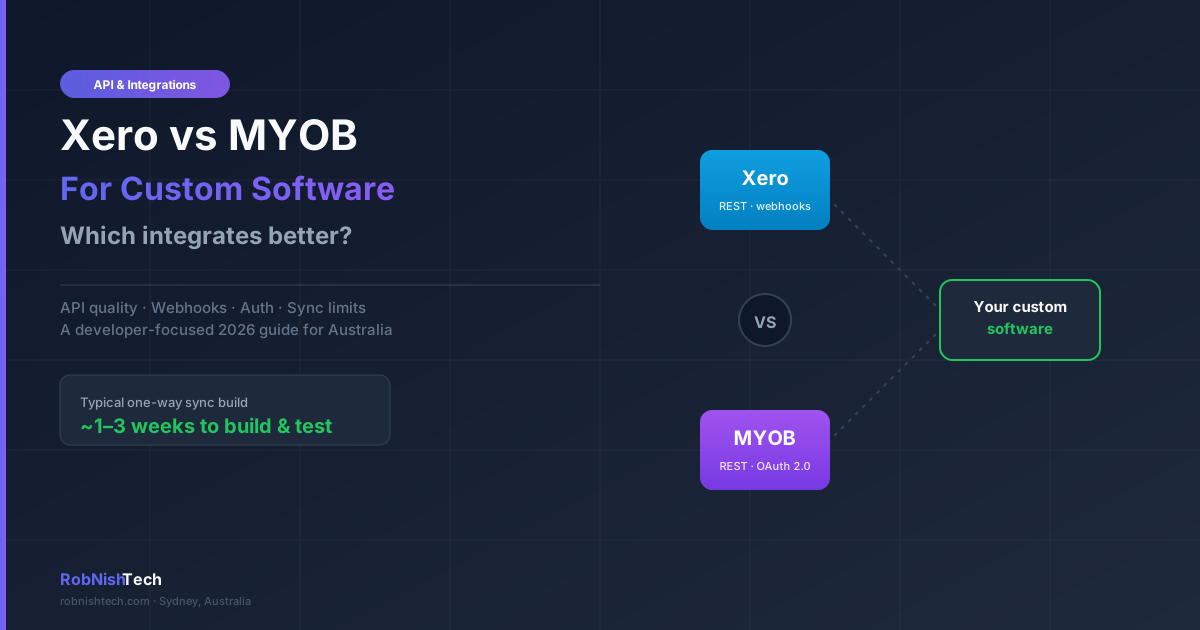
If your business runs on custom software but does its books in Xero or MYOB, those two systems eventually need to talk to each other. The question of which accounting platform integrates better with custom software comes up in almost every project where we connect an internal tool, web app, or SaaS product to a client's finance stack.
Most "Xero vs MYOB" comparisons are written for business owners choosing accounting software. This guide is different. It is written for founders, operations managers, and technical decision-makers in Australia who already have, or are about to build, custom software, and need to know which platform is the safer and cheaper one to integrate with. Both are capable accounting systems. The differences that matter for a build are in the APIs, not the dashboards.
Why the Platform Choice Matters for Integration
When you connect custom software to an accounting platform, you are not just "syncing data". You are depending on someone else's API for a part of your business that touches money. That dependency shapes your build in a few concrete ways.
The quality of the API decides how much code you write and how much of it is defensive. A clean, well-documented API with predictable behaviour means fewer surprises and a faster build. A patchy one means more time spent handling edge cases, which costs you in both budget and ongoing maintenance.
The authentication model decides how your integration stays connected. Modern accounting APIs use OAuth 2.0, which involves access tokens that expire and refresh tokens that keep the connection alive. If that flow is handled poorly, your integration quietly stops working until someone reconnects it.
Webhook support decides whether your software finds out about changes in real time or has to keep asking. Without webhooks, you poll the API on a schedule, which is slower and burns through rate limits. With them, the accounting platform tells your system when something changes.
Key Takeaway
For custom software, the accounting platform's API quality, authentication model, and webhook support matter far more than the features shown in a marketing comparison. These are the things that decide your build cost and how reliable the integration stays over time.
Xero's API for Developers
Xero is widely regarded as the more developer-friendly of the two in Australia. It offers a modern REST API, OAuth 2.0 authentication, and a large public ecosystem of connected apps. For a custom build, several things make it easier to work with.
The documentation is thorough and the API surface is consistent. Invoices, contacts, items, payments, and bank transactions are all accessible through predictable endpoints, which means less guesswork during development. Xero also supports webhooks for several record types, so your software can react to changes such as a new invoice or a contact update rather than polling on a timer.
Xero's API does enforce rate limits, and you have to design around them. There are limits on calls per minute and per day per organisation, so a well-built integration batches requests, caches where it can, and handles the "too many requests" response gracefully rather than failing. This is normal API engineering, not a flaw, but it is something your build has to account for.
If you want a deeper look at the Xero side specifically, we cover it in detail in our Xero API integration guide.
MYOB's API for Developers
MYOB also provides REST APIs and OAuth 2.0 authentication, and it remains a strong choice for many Australian businesses, particularly those with established MYOB workflows or industry-specific needs. From an integration standpoint, there are a few characteristics worth understanding before you commit.
MYOB has two product lines that matter here: AccountRight and MYOB Business. AccountRight historically supported both cloud-hosted and locally hosted company files, and the way you connect differs between them. A cloud file is reachable through MYOB's API online, while a file hosted on a local machine requires a different access path. This variation is the main thing that adds complexity compared with Xero's single cloud model, so the first scoping question for any MYOB build is always "where does the company file live?".
Once connected, MYOB lets you read and write the core records you would expect: invoices, contacts, items, and journals. The trade-off relative to Xero tends to be a smaller third-party app ecosystem and more variation in how you handle authentication and company-file selection. None of this makes MYOB a poor choice, but it usually means your developer spends a little more time on setup and connection logic.
Head-to-Head: What Actually Affects Your Build
Here is how the two compare on the factors that change a custom software project, rather than the features a business owner compares when choosing accounting software.
API model. Both offer REST APIs with OAuth 2.0. Xero presents a single, consistent cloud model. MYOB's AccountRight introduces cloud-versus-local variation that you have to handle explicitly.
Documentation and ecosystem. Xero has a large public app marketplace and extensive developer documentation. MYOB's ecosystem is smaller and more focused on industry-specific integrations.
Webhooks. Xero supports webhooks for several record types, which enables near real-time sync. MYOB's real-time capabilities are more limited, so polling is more common, which affects how fresh your data is and how you manage rate limits.
Connection stability. Both use token-based authentication that must be refreshed automatically. The engineering effort to keep a connection alive is similar; the difference is that MYOB's company-file model gives you one more thing to get right.
Migration risk. Neither platform locks you in if you design your integration behind a clean internal boundary. If you call the API directly throughout your codebase, both are expensive to move off later.
Key Takeaway
For a brand-new custom software build where you control the finance stack, Xero usually involves less integration friction. If the business is already committed to MYOB, a solid MYOB integration is entirely achievable. The right answer depends on where the business already is, not on one platform being universally better.
Which One Should You Build On?
If you are starting fresh and the accounting platform is still an open decision, Xero is typically the lower-friction choice for custom software integration in Australia, thanks to its consistent cloud API, webhook support, and large ecosystem.
If the business already runs on MYOB and is happy with it, that is usually a reason to build on MYOB rather than force a finance-team migration just to make a developer's life easier. Switching accounting platforms is disruptive to the people who do the books, and that cost often outweighs the integration savings. A well-built MYOB integration is reliable and maintainable.
The decision should weigh three things: where the business already keeps its accounts, how much real-time sync the workflow genuinely needs, and how complex the records you are syncing are. We help clients work through exactly this trade-off as part of how we scope integration work.
Common Integration Projects in Australia
In practice, most accounting integrations we see fall into a handful of patterns, and the platform choice affects each one.
Pushing invoices from a custom system into the accounting platform is the most common. A booking system, job-management tool, or e-commerce backend creates an invoice in your software, and the integration writes it into Xero or MYOB so the finance team does not re-key it.
Syncing contacts and customers keeps your CRM or operations tool and your accounting platform in agreement about who your customers are, avoiding duplicates and mismatched details. For teams using HubSpot, the same principle applies to HubSpot CRM integration with Xero and SaaS workflows.
Reconciling payments brings payment data, often from Stripe or a bank feed, together with invoices so the business can see what is paid and what is outstanding without manual checking.
Reporting and dashboards pull figures out of the accounting platform into a custom dashboard, giving owners a live view of cash position, outstanding invoices, or revenue by product line. These read-only integrations are usually the simplest to build on either platform.
How to Scope the Integration Properly
Whichever platform you choose, the integration succeeds or fails on scoping, not on which logo is on the accounting software. Before any code is written, a good scope answers a few questions.
Which records sync, and in which direction? One-way invoice push is far simpler than two-way sync of contacts, invoices, and payments. Being clear about direction controls both cost and risk.
How are duplicates and conflicts handled? If the same customer can be created in both systems, you need a matching rule so you do not end up with two records. This is one of the most common sources of messy data.
What happens when a sync fails? A reliable integration retries transient errors, queues records that cannot be processed yet, and alerts a human when something needs attention, rather than failing silently.
Where does the company file live, especially for MYOB? Confirming cloud versus local access early avoids a surprise mid-build.
Getting these answers down first is what separates an integration that quietly works for years from a brittle script that breaks the first time a token expires. This is the core of our API integration and automation work, and it applies equally to Xero and MYOB. If you are weighing up an accounting integration and want a clear view of the trade-offs for your specific setup, get in touch.
Frequently Asked Questions
Is Xero or MYOB easier to integrate with custom software?
Xero is generally easier to integrate with because it has a modern REST API, well-documented OAuth 2.0 authentication, and webhooks for several record types. MYOB also offers a REST API, but its AccountRight platform has more variation between cloud and locally hosted company files, which can add complexity. For most greenfield custom software builds in Australia, Xero involves less integration friction.
Does MYOB have a public API for custom software?
Yes. MYOB provides REST APIs for both its AccountRight and Business (formerly Essentials) products, with OAuth 2.0 authentication and developer registration. You can read and write invoices, contacts, items, and journals. The main differences from Xero are around how company files are accessed and the level of webhook support, so the right choice depends on your specific workflow.
Can I switch from MYOB to Xero later without rebuilding everything?
Partly. If your integration is built behind a clean internal layer that separates your business logic from the accounting provider, switching providers means rewriting that one adapter rather than your whole system. If your code calls the accounting API directly throughout the application, a switch is far more expensive. Designing for this from the start is a small amount of extra work that protects you later.
How long does a Xero or MYOB integration take to build?
A focused one-way sync, such as pushing invoices from your system into the accounting platform, can often be built and tested in one to three weeks. Two-way sync with contacts, line items, payments, and error handling typically takes longer because of edge cases like duplicate matching and failed syncs. The timeline depends on how many record types you sync and how clean your existing data is.
Do accounting API integrations break, and how do you prevent it?
Yes, integrations can break when tokens expire, API versions change, or rate limits are hit. The way to prevent silent failures is to build automatic token refresh, retry logic for transient errors, a dead-letter queue for failed records, and monitoring that alerts you when syncs stop. These safeguards are part of building a reliable integration rather than a one-off script.
Need Help With Your Next Project?
We build custom software, integrate AI, and automate workflows for businesses across Australia.
Get in Touch