When a business invests $50,000 to $200,000 in custom software, the obvious next question is: was it worth it?
This article gives you a practical framework for measuring custom software ROI — what to count, when to measure it, and how to present the result to your team or board. It is written for Australian business owners, operations managers, and startup founders who are either evaluating a software investment or trying to understand the value of a system they have already built. If you are still deciding whether to build at all, our guide on when to invest in custom software covers the signs your business is ready.
What ROI Means for Custom Software
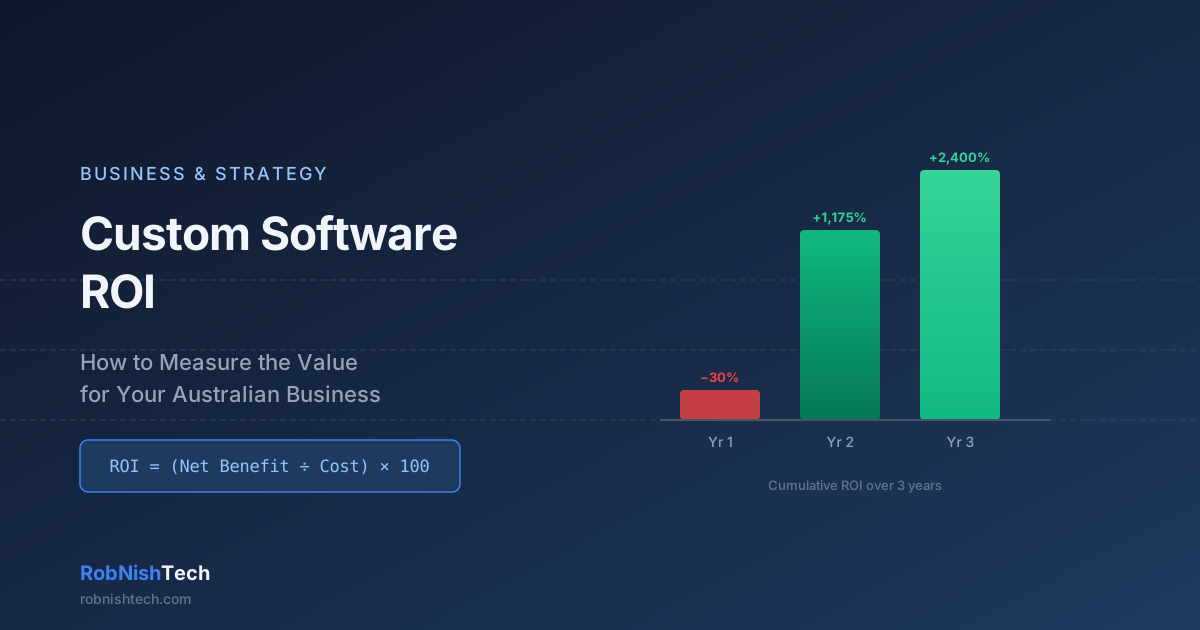
Return on investment (ROI) is a ratio: the net benefit you received divided by what you spent to get it. The formula is straightforward:
ROI = (Net Benefit ÷ Total Cost) × 100
If you spent $80,000 on a custom system and it delivered $160,000 in measurable value over 12 months, your ROI is 100%.
The challenge with custom software is that "net benefit" is not a single line item. It is a combination of time saved, errors reduced, revenue enabled, and costs avoided — spread across months and departments. The sections below help you identify and quantify each of these.
Step 1: Calculate the Full Cost
Most businesses undercount the true cost of a custom software project. Include all of the following when building your cost baseline:
- Development cost — the contract value paid to your developer or agency.
- Internal team time — hours spent by your staff on requirements, testing, and feedback during the build.
- Onboarding and training — time for staff to learn and adopt the new system.
- Ongoing maintenance — annual support retainer, bug fixes, or hourly work after launch. Budget this at roughly 15–25% of the build cost per year.
- Hosting and infrastructure — cloud services, database costs, domain, and monitoring.
For a typical mid-sized custom system in Australia, total first-year cost often sits between $60,000 and $150,000 once all of the above are included. See our custom software cost guide for a detailed breakdown of what drives these figures.
Step 2: Identify Your Benefit Categories
Benefits from custom software fall into four categories. You do not need to count every one — focus on the two or three that are most significant for your business.
Time savings
Convert labour time to a dollar value. If a process takes 20 hours per week at $50 per hour, that is $52,000 per year. If the new software reduces this to 4 hours per week, the annual saving is $41,600. Use the fully loaded cost of the staff member — including superannuation, leave entitlements, and overheads — for a realistic figure.
Error and rework reduction
Manual processes create errors. Errors create rework, refunds, and customer complaints. Estimate what errors cost your business each month — staff time to fix them, credit notes issued, and customer churn — and track whether this falls after go-live. Even a modest reduction can represent thousands of dollars per year.
Revenue enabled
Some custom software directly enables revenue that would not have been possible otherwise. A customer portal that reduces sales friction, an automated quoting tool, or a booking system that captures enquiries after hours all fall into this category. Be conservative when estimating revenue uplift and document your assumptions clearly.
Costs avoided
Custom software sometimes replaces multiple SaaS subscriptions. If you were paying $3,000 per month across five tools that the new system replaces, that is $36,000 in annual savings. Include any staff time previously spent managing data between disconnected tools.
Key Takeaway
Pick two or three benefit categories that clearly apply to your situation. Documenting a handful of well-supported figures is more credible than a long list of speculative gains.
Step 3: Use a 3-6-12 Month Review Framework
Do not try to measure ROI at day one. Custom software needs a stabilisation period before it delivers full value. A structured three-point review gives you meaningful data at each stage.
- 3-month mark: Is the system stable? Are staff using it consistently? Measure adoption rate and identify any rework or fixes that ate into your original cost estimate.
- 6-month mark: Start measuring operational metrics — time per task, error rates, enquiries handled, and tool subscriptions cancelled. Compare to your pre-software baseline.
- 12-month mark: Full ROI review. Annualise the benefits measured at six months. Include scope additions and support costs. Calculate your net ROI using the formula above.
This cadence works well for Australian SMBs where the investment is significant but the internal team is lean. It avoids the trap of declaring the project a failure at month two when the system is still bedding in.
Practical Example: A Sydney Operations Business
Consider a Sydney-based services business that builds a custom scheduling and invoicing system for $95,000. Here is how the ROI analysis looks over two years.
Year 1 costs
- Development: $95,000
- Internal team time during build: approximately $8,000
- Hosting and annual support: $6,000
- Total Year 1 cost: $109,000
Year 1 benefits (measured at 12 months)
- Admin time reduced by 18 hours per week at $45 per hour: $42,120
- Billing errors and credit notes eliminated: $12,000
- Xero reconciliation time saved: $8,000
- Three SaaS tool subscriptions cancelled: $14,400
- Total Year 1 benefit: $76,520
Year-1 ROI: approximately −30%. A net negative result is common in year one because the full development cost falls in the same period as partial benefits. This is expected and not a sign the investment was wrong.
Year 2 and beyond
In year two, the development cost is fully amortised. Ongoing costs are hosting and support: $6,000. Benefits remain at roughly $76,520. Year-2 ROI is approximately 1,175%. The business recovers its full investment around the 18-month mark.
This pattern — a year-one dip followed by a steep year-two return — is typical for well-scoped custom software development projects. It is the reason comparing year-one costs against year-one benefits in isolation leads to an unfairly negative conclusion.
When Quantitative ROI Is Not the Whole Picture
Some custom software value cannot be expressed as a dollar figure, but it still contributes meaningfully to the business case:
- Competitive differentiation — a capability your competitors cannot easily replicate with off-the-shelf tools.
- Compliance and risk reduction — avoiding an audit finding, a data breach, or a regulatory penalty.
- Customer experience — faster response times, fewer errors, and more consistent service that builds long-term trust.
- Team capacity — staff freed from manual work who can focus on higher-value tasks.
- Data visibility — dashboards and reporting that give management real-time insight into operations.
When presenting the ROI to a board or investor, include a qualitative section alongside the numbers. A statement like "the system also eliminated our dependence on two staff members manually reconciling data each week" adds context that the ROI percentage alone cannot convey.
How to Set Up Your Measurement Baseline
The most common reason businesses cannot calculate ROI after go-live is that they never recorded the baseline before they started. Fix this at the beginning of your project.
Before your build begins, document the following in a simple spreadsheet:
- Current time per week for each task the software will automate or streamline
- Current error or refund rate for affected processes
- Current monthly software subscription spend
- Headcount cost for roles most affected by the change
Our development process includes a discovery phase where we work through these metrics with you before scoping the build. Having a clear baseline makes the post-launch ROI review straightforward rather than speculative.
Common ROI Mistakes to Avoid
- Counting only the development invoice. True cost includes internal time, training, and ongoing support.
- Measuring too early. Give the system at least six months before drawing firm conclusions.
- Not separating one-off costs from recurring ones. Development is a one-time cost. Benefits compound every year.
- Ignoring qualitative value. Some of the best outcomes from custom software are not directly measurable but still matter to the business.
- Comparing to doing nothing. Compare to the realistic alternative — hiring another staff member, maintaining multiple SaaS subscriptions, or continuing to rely on spreadsheets.
For help thinking through whether custom software is the right investment for your situation, read our comparison of custom software vs SaaS for Australian businesses.
Frequently Asked Questions
How long does it take for custom software to pay for itself in Australia?
Most well-scoped custom software projects break even between 12 and 24 months after go-live. Year-one ROI is often negative because the development cost falls in the same period as the early benefits. Year two and beyond tend to show strong positive returns as the development cost is fully amortised.
What is a realistic ROI expectation for custom software?
Over a three-year period, a well-scoped custom software project for a growing Australian business typically delivers a positive ROI of 200–400%. Specific returns depend heavily on the problem being solved, the baseline state of the business, and how consistently the system is adopted by staff.
Do I need to hire someone to track ROI after go-live?
No. A simple spreadsheet reviewed quarterly is enough for most small businesses. Identify three to five measurable metrics before go-live, track them monthly, and run a structured review at the three, six, and twelve-month marks.
Can I include productivity gains in my ROI calculation?
Yes. Time savings are one of the most common and credible ROI inputs for custom software. Convert hours saved to dollars using the fully loaded cost of the staff whose time is being freed, including superannuation and leave entitlements.
How does custom software ROI compare to buying an off-the-shelf SaaS product?
SaaS has lower upfront cost but ongoing subscription fees and feature limitations. Custom software has higher upfront cost but zero per-seat fees and full control over functionality. For businesses with a specific workflow that SaaS tools cannot fit cleanly, the break-even point against SaaS often arrives within two to three years.
Need Help With Your Next Project?
We build custom software, integrate AI, and automate workflows for businesses across Australia.
Get in Touch