Most early-stage founders arrive at their first discovery call with a list of 30 features they want in version one. By the end of a properly run scoping session, that list is usually 8.
The gap between what founders want and what they actually need in an MVP is where most startup budgets get burned. Feature scope creep is not just a technical problem — it is a planning problem that begins before a single line of code is written.
This guide is for Australian startup founders, solo operators, and early-stage product teams who are planning to build an MVP. It covers the frameworks and practical steps that help you decide what belongs in version one and what can safely wait.
Why MVP Scope Is So Hard to Control
Building a minimum viable product sounds simple in theory. In practice, scope creep starts during ideation. You are excited about your product, your investors want to see confidence, and every feature on your list feels important.
The problem is that software development costs scale with complexity. A web application with 8 core features might cost $40,000–$70,000 and take 10–14 weeks. Add 12 more features and you could be looking at $120,000 and 6–8 months — for a product that has not yet proven market fit.
Australian MVP development typically ranges from $30,000 to $150,000 depending on complexity, integrations, and team structure. That range is wide because scope is the primary cost driver. Founders who control scope control their budget.
The goal of MVP feature prioritisation is not to build less. It is to build the right things first, so you can validate your assumptions and iterate with real data.
The MoSCoW Method: A Practical Starting Point
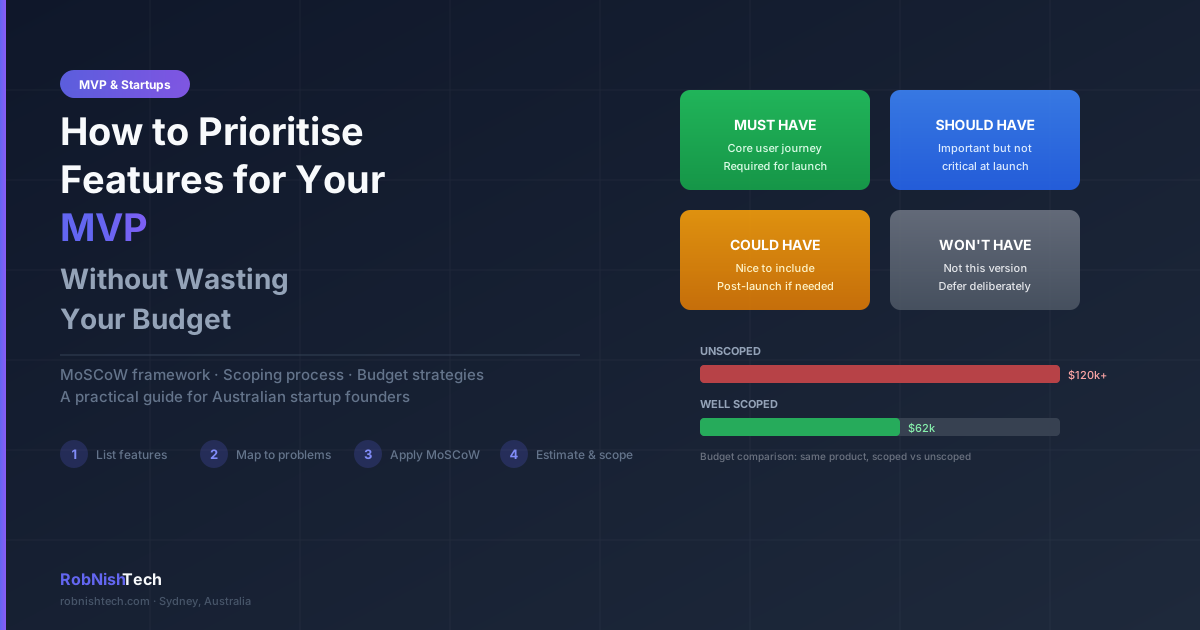
The most widely used MVP prioritisation framework is MoSCoW. It divides features into four categories:
- Must Have — the product cannot work without this feature. It is core to the value proposition and required for launch.
- Should Have — important and expected, but the product can launch without it. Add in version 1.1.
- Could Have — nice to include but not critical. Build post-launch if users ask for it.
- Won't Have (this time) — deliberately excluded from the current scope. Not a permanent no — just not now.
The discipline of MoSCoW is in the constraints. Most founders who try it for the first time discover that their "Must Have" list is much longer than they expected. That is a signal that the core value proposition needs to be sharpened.
Key Takeaway
A useful test: if you removed this feature, would the product still solve the core problem for your first 10 users? If yes, it is probably not a Must Have.
A Step-by-Step Feature Prioritisation Process
1. Write Down Every Feature You Want
Do not filter yet. List everything — every idea, every wishlist item, every "nice to have". This is your complete universe of features.
2. Map Each Feature to a User Problem
For each feature, write one sentence explaining which specific user problem it solves. If you cannot write that sentence, the feature does not belong in the MVP.
Features that solve real, documented problems stay. Features that exist because "other apps have this" or "it would be cool" get moved to the Could Have or Won't Have column.
3. Apply MoSCoW
Go through your feature list with your development partner or team and assign each item to a category. Be honest. Push back on anything in the Must Have column that does not directly enable the core user journey.
4. Estimate Effort for Must Have Features
Once your Must Have list is locked, ask your developer or agency for a rough effort estimate on each item. Some features look simple and are expensive. Some look complex and are straightforward. Early effort estimates help you identify trade-offs before the project starts.
5. Stress-Test Against Your Budget
Take your Must Have list and rough estimates, and check whether they fit your budget and timeline. If they do not, you have two options: remove a feature from Must Have, or find a simpler way to build it.
This is where working with an experienced development team matters. There are often multiple ways to deliver the same user outcome — some far more efficient than others.
Common MVP Scope Mistakes Australian Founders Make
Building an admin panel before the core product. Admin panels, reporting dashboards, and management interfaces are Should Have features, not Must Have. Build them after launch when you know what you actually need to manage.
Adding user roles and permissions before you have users. Multi-role systems add significant complexity. In an MVP, a single user type is almost always sufficient for validation.
Integrating every third-party tool from day one. You probably need one payment integration. You probably do not need three CRM connections, an SMS gateway, and an analytics platform before launch.
Building a mobile app and a web app simultaneously. Pick one. Web first is usually faster and cheaper. Native mobile apps can follow once you have proven the product.
Designing for scale before you have scale. Infrastructure built for 10,000 concurrent users is expensive and mostly wasted if you have 50 users at launch. Build for your real launch scenario, not your aspirational scenario.
What a Well-Scoped MVP Looks Like in Practice
A professional services firm recently came to us wanting to build a client portal. Their original feature list included file sharing and version control, client messaging and notifications, invoice generation and payment tracking, project timeline views with milestone tracking, a mobile app for clients, automated onboarding email sequences, and a reporting dashboard for internal staff.
After a scoping session, the Must Have list for launch was:
- File sharing (upload and download)
- Client-visible project status (three stages: In Progress, Under Review, Complete)
- Invoice generation linked to the existing Stripe account
Everything else moved to Should Have or Could Have. The reduced scope cut development time from an estimated 20 weeks to 11 weeks and brought the budget from a projected $110,000 to $62,000. Version one launched on schedule, and real user feedback shaped what was built in version two.
This is not an unusual outcome. It is what good scoping looks like.
How to Work With a Development Partner on MVP Scope
A good development partner will push back on your scope — not because they want to do less work, but because they understand that a well-scoped MVP has a better chance of success.
When you are evaluating development companies for your MVP, ask:
- How do you approach the discovery and scoping phase?
- Can you show me an example of how you have helped a client reduce their MVP scope?
- What is included in a formal discovery engagement before development starts?
At RobNish Tech, we run a structured discovery process before any MVP engagement. This involves mapping user flows, identifying the critical path, and producing a scoped feature list and effort estimate — before committing to a full development budget.
You can read more about our approach to MVP and SaaS development, or explore related topics on our blog — including our guide on how to build an MVP for investors in Australia and SaaS development for Australian startups.
Frequently Asked Questions
How many features should an MVP have?
There is no universal number, but a useful rule of thumb is to focus on the features that support one complete user journey from start to finish. For most SaaS or web application MVPs, that might mean 5–10 features. The goal is not a minimum number of features — it is the minimum set of features that lets a real user complete the core task the product is designed for.
How long does an MVP take to build in Australia?
A well-scoped MVP with a clear feature set typically takes 8–16 weeks from kick-off to launch. Simpler products with a tight scope can be done in 6–10 weeks. Complex applications with multiple integrations, custom logic, or large data requirements take longer. Timeline depends heavily on scope, not just on the team size.
How much does an MVP cost in Australia?
Australian MVP development typically costs between $30,000 and $100,000 for most early-stage web applications, depending on complexity and the development approach. Simple proofs of concept can be built for less. Enterprise-grade or heavily integrated products cost more. Getting a scoped estimate from a development partner early in the process is the best way to understand your specific cost range.
Should I build a mobile app or a web app for my MVP?
For most business and SaaS MVPs, a web application is the better starting point. Web apps are faster and cheaper to build, easier to update, and accessible across all devices through a browser. A native mobile app adds cost and complexity. Build web first, validate the product, then invest in mobile if your users need it.
What is the difference between an MVP and a prototype?
A prototype is a design or simulation of the product — often clickable screens or wireframes that show how the product will work, but with no real functionality behind them. An MVP is a working product with real functionality that real users can use. Prototypes are used to validate ideas and get stakeholder buy-in. MVPs are used to validate product-market fit with real users.
Need Help With Your Next Project?
We build custom software, integrate AI, and automate workflows for businesses across Australia.
Get in Touch