If you have an idea for a software product that other businesses or individuals could pay to use on a subscription basis, you are thinking about building a SaaS product. Software as a service is the dominant delivery model for modern software — from Atlassian and Canva to thousands of niche tools solving specific industry problems.
Building a SaaS product is a different challenge from building an internal tool or a marketing website. You are creating something that needs to handle multiple customers, subscriptions, user permissions, and ongoing feature development. Done well, it becomes a scalable, recurring revenue business. Done poorly, it drains budget without reaching a viable product.
This guide covers what SaaS development actually involves, how much it costs in Australia, why starting with an MVP is nearly always the right approach, and what to look for in a development partner.
What Is SaaS Development?
SaaS development is the process of designing, building, launching, and maintaining a cloud-hosted software product that customers access via subscription — usually through a browser or API. Unlike custom internal tools built for a single organisation, a SaaS product must work for many different customers at once, each with different data, roles, and usage patterns.
The technical requirements that distinguish SaaS from a standard web application include:
- Multi-tenancy: Multiple customers share the same infrastructure without seeing each other's data.
- Authentication and role management: Users, admins, and billing contacts each have different access levels.
- Subscription billing: Payment tools like Stripe handle plan upgrades, downgrades, trials, and failed payments.
- Onboarding flows: New customers need to activate and start using the product without hand-holding.
- Usage tracking and limits: Different pricing tiers typically include different feature or usage caps.
- Scalable infrastructure: The product must grow as customer numbers grow, without manual intervention.
Not every SaaS product needs all of these on day one. But knowing which ones apply to your specific product is an important part of scoping the build correctly.
Should You Build a SaaS Product or Buy One?
This is always the right question to start with. If a well-established product already solves your problem at a reasonable price, building your own is rarely justified. The economics of competing with an established SaaS in a mature category are difficult.
Where building makes sense:
- Niche vertical problems: Your target industry has specific workflows, data structures, or compliance requirements that generic tools handle badly.
- Competitive advantage: The software itself is your product differentiation, not just how you use it.
- Integration requirements: You need deep integration between systems that off-the-shelf tools cannot provide.
- White-labelling: You want to offer software under your own brand to your customers.
- Business model: Recurring software revenue is the goal, not just a tool to support another service.
If you are building an internal business tool that only your own organisation will use, you are probably looking at custom software development rather than a SaaS product.
How Much Does SaaS Development Cost in Australia?
SaaS development costs in Australia vary significantly based on scope, team size, and what you build first. Realistic ranges for working with an experienced Australian development team:
| Build Scope | Typical Cost (AUD) |
|---|---|
| Lean MVP (core feature set only) | $25,000 – $70,000 |
| Mid-stage SaaS with billing and onboarding | $80,000 – $200,000 |
| Full platform with integrations and admin tooling | $200,000+ |
Offshore or freelancer options can reduce initial costs but often add project management overhead and quality risk, particularly for the architectural decisions that affect the product long-term.
Key cost drivers include:
- Number of user roles and permission levels
- Subscription billing complexity (trials, proration, multi-seat plans)
- Third-party integrations (CRMs such as HubSpot, accounting tools, payment gateways)
- Real-time features (notifications, live dashboards, messaging)
- Whether a mobile app is required alongside the web application
Key Takeaway
A focused MVP with three to five core features is almost always a better investment than a feature-complete platform that takes a year to build and has never been tested with paying customers.
Start With an MVP, Not a Full Platform
An MVP — minimum viable product — is the smallest version of your SaaS product that delivers enough value for a customer to pay for it. It is not a rough prototype; it is a working product, just a narrow one.
The case for starting with an MVP:
You learn what actually matters. The features you think customers want and the features they are willing to pay for are often different. An MVP lets you find out quickly without spending your full budget first.
You reach revenue faster. A working MVP with paying customers is more fundable, more improvable, and more sustainable than a full platform with no users.
You reduce technical risk. Building incrementally means problems surface earlier and cost less to fix.
A well-scoped SaaS MVP typically includes: the core data model and business logic, authentication and user management, one pricing tier and basic billing, a simple onboarding flow, and the minimum UI needed for customers to complete their core task.
For more detail on scoping an MVP for investors or early customers, see our guide on how to build an MVP for investors in Australia.
Our MVP and SaaS development service is designed for founders who want to move fast, validate with real users, and build on a solid technical foundation rather than throwaway code.
What to Look for in a SaaS Developer in Australia
Whether you hire a development team, a freelancer, or an agency, the questions you ask during selection matter more than the price quoted.
SaaS-specific experience. General web development and SaaS development are different disciplines. Ask for examples of multi-tenant applications, subscription billing implementation, and role-based access control in previous projects.
Product thinking alongside technical execution. A good SaaS partner will ask about your target customer, your pricing model, and your growth plan — not just your feature list. This context shapes important technical decisions.
Deployment and infrastructure planning. Ask where the product will run, how it will scale, how deployments are managed, and how incidents are handled. These questions separate experienced teams from developers who have only built simple web apps.
Clear scope and milestone structure. Our development process breaks every engagement into discovery, build, and deployment phases with defined deliverables. Avoid teams that begin building without a documented scope.
Post-launch support. SaaS products require ongoing updates, bug fixes, and new feature development. A team that disappears after launch is a risk worth evaluating before you sign anything.
Common Mistakes Australian SaaS Founders Make
Building too much before launch. Scope creep in the early stages is the most common and most expensive mistake. Prioritise ruthlessly and cut anything that is not core to the value proposition until you have validated demand.
Skipping proper authentication and security. SaaS products handle customer data. Authentication, session management, and data isolation need to be built correctly from day one, not retrofitted later when fixing them is significantly more expensive.
Underestimating billing complexity. Subscription billing sounds straightforward but quickly becomes complicated with trials, plan changes, failed payments, refunds, and tax handling. Use a battle-tested tool like Stripe and integrate it early in the build.
Not planning for onboarding. A product that requires a support call to set up will not scale. A basic in-app onboarding flow is worth building before adding new features.
Choosing a technology stack for the wrong reasons. Stack decisions should be based on what the team can build reliably and maintain over time, not on trends or investor expectations.
Frequently Asked Questions
What is SaaS development?
SaaS development is the process of building a cloud-hosted software product that multiple customers subscribe to and access online. It involves more than a standard web application — it requires multi-tenancy, subscription billing, user management, and scalable infrastructure.
How much does SaaS development cost in Australia?
A lean MVP typically costs between $25,000 and $70,000 AUD. A more complete SaaS platform with billing, onboarding, and integrations typically costs $80,000 to $200,000 AUD or more, depending on complexity.
How long does it take to build a SaaS product?
A focused MVP typically takes three to five months to design, build, and launch. A more complete platform with integrations and admin tooling can take six to twelve months or longer.
Should I build a SaaS product or use existing software?
If existing software solves your problem at a reasonable price, use it. Building makes sense when your niche has specific requirements that generic tools handle poorly, when the software is your competitive advantage, or when recurring software revenue is your business model.
Can I build a SaaS product with a limited budget?
Yes, if you scope aggressively. A focused MVP with three to five core features can reach paying customers without exhausting your full budget. The key is prioritising the features that deliver the core value and cutting everything else until you have validated demand.
What technology is used to build SaaS products in Australia?
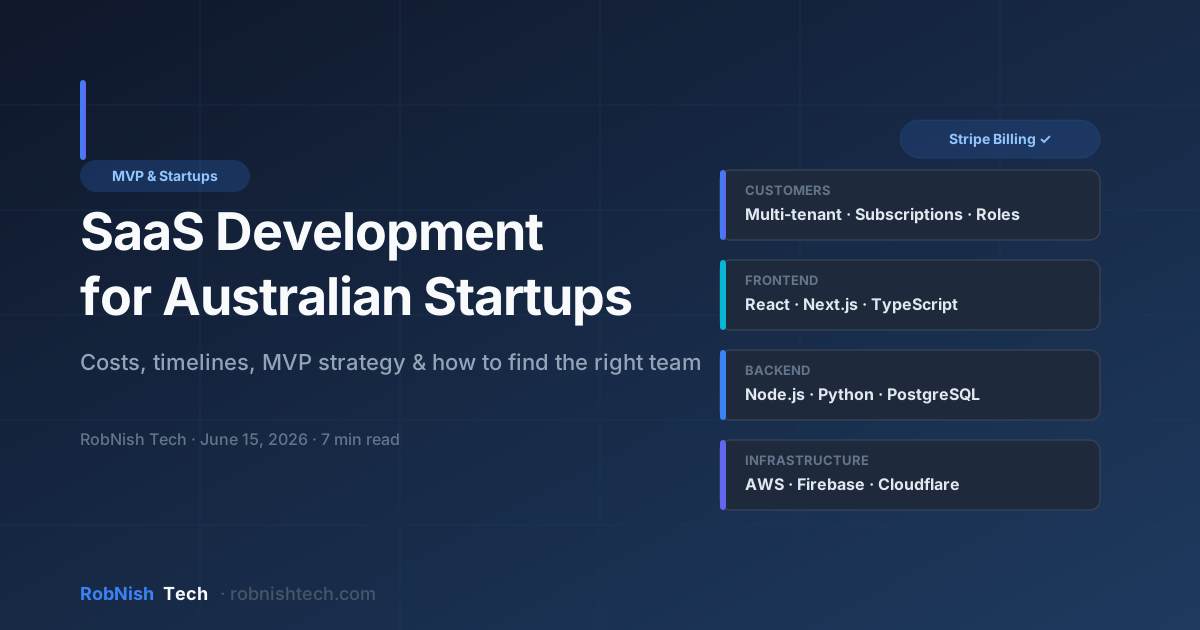
Common stacks include React or Next.js on the frontend, Node.js or Python on the backend, PostgreSQL or a similar relational database, Stripe for billing, and cloud platforms like AWS, Firebase, or Cloudflare for hosting and deployment.
Need Help With Your Next Project?
We build custom software, integrate AI, and automate workflows for businesses across Australia.
Get in Touch